
"In the world, but not of it"
Or, Yoga, politics, and what we owe one another

Elon Musk’s recent foray into politics ended rather messily for him, and he has famously declared that he’s dissatisfied with the whole process. Whatever we may think of his efforts and their results, it’s pretty obvious what happened: a wealthy technocrat with delusions of godhood tried to reduce politics down to aesthetics, and it fell apart when it ran into actual people.
On a smaller scale, we see the same thing happen any time someone in the spiritual or occult communities says that they hate politics. Often, they’ll go on to extol some purely abstract vision of how civic life “should” be, whether it resemble Skinnerian technocratic dictatorship, a literalized Chuang Zhou agrarian anarchism, spiritual communism, radical individualism, or Plato’s philosopher-king. These are all aesthetic choice, which rely upon predictable billiard ball-type objects, and fall apart as soon as actual subjects become involved.
When we say that we “hate politics”, what we usually mean is that we hate the fuss and muss. Politics is just what happens when two or more people have to live with one another and make decisions together. Political systems develop as the numbers get higher than a handful; they are founded in the need for some type of cooperation and compromise. Authoritarianism, dictatorship, etc., arises from the preference for simplicity, or at least away from the need to account for a diversity of needs, wants, and opinions. Eventually, all such hierarchical structures must fall or soften for the simple fact that real, live humans produce too many variables and too much pushback.
In spiritual circles, Traditionalism (note the capital T) presents is a metaschool which attempts to stand apart from the world, judging every piece of culture according to how well or poorly it fits an ahistorical aesthetic of Perennial Truth. This, ultimately, is founded in a strict reading of Plato, conflating, as the great philosopher did, the political, the artistic, the economic, and the spiritual. Traditionalism therefore draws all of the great spiritual and religious traditions together, but not in a way which celebrates or learns from their distinctness; the Traditionalist prefers to smear them together and flatten them out, effacing the uniqueness of each in the same way that Plato’s philosopher-king, the fascist dictator, and the Communist party leader wish to do to ethnic groups and individuals.
Nevertheless, there is real value in the exercise of standing oneself apart from history. The problem with Traditionalism and similar efforts is in the anxiety at the root of it, the fear of change, of perceived loss, and, ironically, of mixing “incompatible” cultural artifacts. Traditionalism is a casting-back toward a past which never was, nor ever could be. The standing-aside of Christ, of the Buddha, of Patanjali, and others, is never a denial of the facts of life. In these traditions, you will find varying degrees of renunciation, but broad agreement that what ultimately must be renounced is not “stuff” but our attitude toward the stuff. What Traditionalists always seem to get wrong — often willfully — is the emphasis placed on compassion. To a Traditionalist, things like empathy, charity, and love are obstacles in the way of arid aesthetic perfection, while to the living traditions themselves, they are irreducibles without which neither society nor spirituality can develop.
The other extreme, just as prevalent, is a sort of individualist anarchism. Many Westernized schools of Buddhism, Daoism, Yoga, and Tantra fall this way, when not absorbed by Traditionalism. The outcome, however, is similar, in that the practitioner is encouraged to “drop out” of all political involvement whatsoever. This is usually justified by the yogic virtues of equipoise and detachment. These virtues, however, are contextualized in the Yoga traditions alongside compassion, amity, and reason. Equipoise and detachment are for the sake of self-discipline, ways to undercut one’s own suffering, not means of remaining comfortably aloof when others suffer. Some yogic traditions are more concerned with the social fabric than others, but all of them admit that we cannot cut ourselves off from others with impunity. Even the likes of Sri Ramana Maharshi wept at the news of Gandhi’s death. He realized that it was not his mission to redress the political and economic injustices done to India, but he did not doubt that it was somebody’s mission, and a necessary, even divine, one at that.
What we see at either end is an abdication of responsibility to citizenship in the world. At one extreme is the insistence that the responsibility is on others to conform to our aesthetic preference, with sayings like, “There are no rights, only duties.” At the other is the misunderstanding of liberty as freedom from constraint, responsibility, or causality. We know from history, however, that rights and duties are hand-in-glove. Liberty arises from, and is preserved by, our taking good care of one another and stewarding our world responsibly. Failure to account for causal relationships and mutual dependence undermines freedom — even spiritual freedom, because we are left with less time and energy to devote to its achievement.
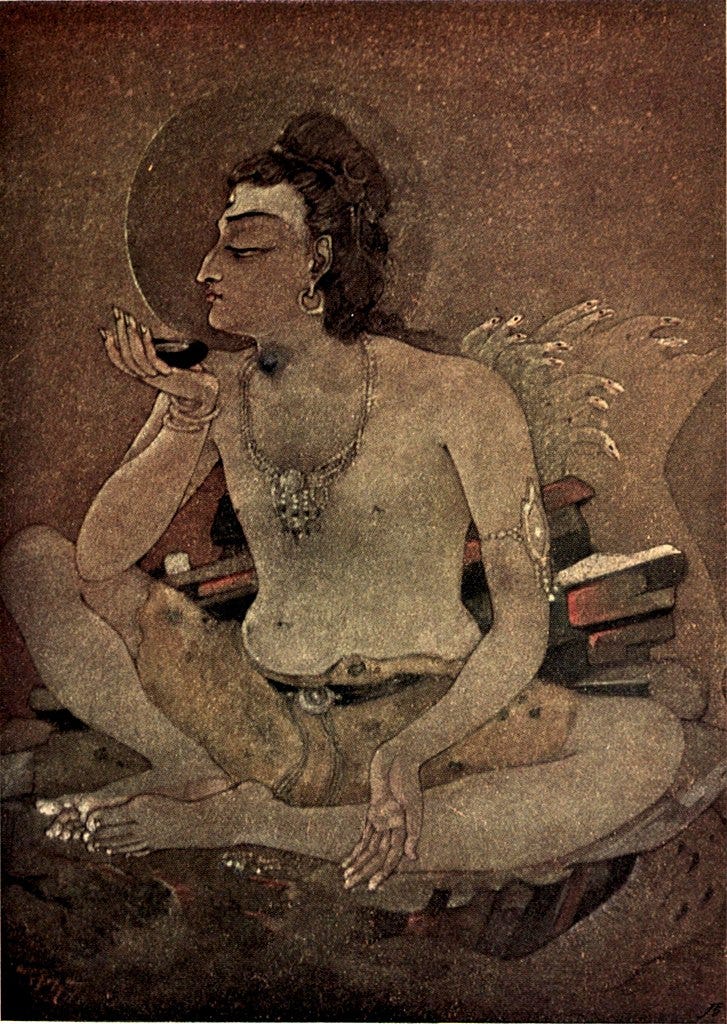
The Yoga traditions all acknowledge that in some way, the essence of our consciousness is not limited by the rules of this world. We are not only our human frames and brains. As such, we are “not of this world” in a sense that we can actually come to experience. But the irony which plays against both amoral transcendentalism and apolitical quietism is that the more we root ourselves in that experience, the more kinship or even co-identity we come to feel with our fellow creatures. In an absolute sense, perhaps we do not have anything like responsibility, but so long as we are upon the wheel, even if just by a finger or toe, our actions have something to do with the momentum of the whole. Insofar as that is true, your suffering is my suffering, and I must learn to act accordingly. Like Lord Shiva, we must each drink our portion of the world’s poison and learn to transmute rather than be overcome by it.
I agree with this. On my spiritual journeys I’ve done across both. To ignore politics completely is ridiculous and not acting with awareness. Well on the other side the opposite extremes.
As a queer bipoc person, I have no choice but to be aware. As regardless of if I’m paying attention or not. I’ll be affected. It’s a balancing act that’s for sure.
Thank you for sharing. 🙏🏽
Well said. Your writing is always eloquent and with useful perspectives. The whole matter at hand here does, indeed, come down to what we make of anything in our earthly existence. It can help or hinder us in our quests. But the onus is on us individually.